Bioengineering ยท Custom-made implants

Custom-made implants

Think simple โ€“ act fast โ€“ do precise. The future in orthopedic science is custom surgical solutions through 3D-printing technology.

  • Titanium Ti6Al4V
  • PEEK
  • Lattice structures
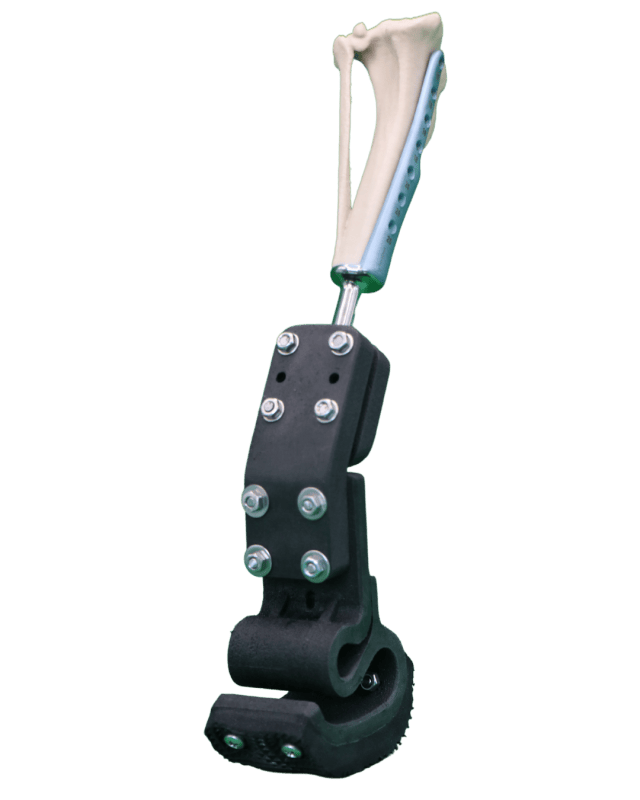
Custom-made ITAP implants and a 3D-printed titanium plate
Designed with CAD-CAE
3D-printed for one patient

custom-made implants

Every implant geometry your case needs

Customizing veterinary is the future. Our engineering team is ready to create every implant geometry and shape that will fulfil your highest requirements. All implants are developed with advanced CAD-CAE Systems and produced with 3D-Printing technology using Titanium (Ti6Al4V) and PEEK (PolyEtherEtherKetone) materials.

We have designed several types of customized implants such as ITAP, vertebrae, arthrodesis plates and PGR. At bio3Dtech we believe that the key to success in complex orthopedic cases is customization.
What makes custom-made implants important

  • Design that meets patientโ€™s special needs.
  • Better fitting.
  • More precise.
  • Geometry freedom.
  • Easy to install.
  • Lattice and porous structure ensure rapid growth of the bone.
  • Surgery goes faster.
  • Aesthetic and anatomical reconstruction.
  • Faster recovery after surgery.

applications

Veterinary applications

Titanium and PEEK implants designed for one patient, for the cases where standard implants reach their limits.

  • Intraosseous Transcutaneous Amputation Prosthesis (ITAP)

    A bone-anchored implant that passes through the skin and connects the limb directly to an external prosthesis.

  • Craniomaxillofacial plates

    Patient-specific plates for skull and jaw reconstruction that restore the anatomy and the aesthetics.

  • Arthrodesis

    Arthrodesis plates matched to the bone contour and to the angle planned with the surgeon.

  • Custom plates

    Plates of any geometry for complex fractures, deformities and corrective osteotomies.

  • PGR replacement

    Patellar groove replacement implants shaped to the femur of the individual patient.

watch

Designed in 3D, made for one patient

cases

Our implants in practice

materials

Materials

We choose the material for every case: titanium for strength, PEEK for a bone-like modulus, biocompatible resin for guides and models.

Titanium Ti6Al4V

Titanium is the most commonly used material for implants in the orthopedic field. Titanium and titanium-based alloys are prized for high mechanical strength, a high strength-to-weight ratio, and better corrosion resistance than stainless steel. Implants made of Titanium provide also a reduced risk of tissue reaction.

3D-Printing technology allows us to produce implants that are equally as good as machined models.

PEEK โ€“ PolyEtherEtherKetone

PEEK is a high-performance material, part of the polyaryletherketone (PAEK) family. PEEK implants may provide a strong, rigid reconstruction along with excellent anatomical fit and contour. PEEK has clear advantages over Ti because of its radiolucency and an elastic modulus much closer to that of bone. Natural PEEK’s modulus is of the same order as cortical bone’s, while titanium is several times stiffer than bone.

Elastic modulus, GPa

Cortical bone17.7
PEEK8.3
Titanium alloy116
3D-printed surgical guides made of biocompatible resin

Biocompatible resin

Biocompatible resin is perfect for applications that require non-cytotoxic, non-sensitization, and non-irritation properties. At bio3Dtech we use these resins to make surgical guides, anatomical bones and other surgical instruments.

  • CytotoxicityISO 10993-5:2009
  • SensitizationISO 10993-10:2021
  • IrritationISO 10993-23:2021

next step

Need an implant for a complex case?

Send us the CT/DICOM data of your patient and our engineers will design an implant that fits its anatomy, in titanium or PEEK.